University of Bahrain | College of IT | Department of Computer Engineering
Securing Remote Workforce: A Robust Solution Plan
"Redefining remote work infrastructures in the security context"
Abstract
This project presents a secure remote network solution plan designed to help organizations protect
their internal assets while enabling a flexible remote workforce. Through an extensive literature
review (2020–2025) and a survey of 170 respondents on cybersecurity awareness, we analyzed the most
prevalent attacks in the remote work era and the essential security practices needed to mitigate them.
We then evaluated four key technologies: SSL VPN, Zero Trust Architecture (ZTA), SD-WAN, and SASE against
criteria such as performance, scalability, deployment complexity, and trust model, and designed three
integrated solution plans tailored to different organization sizes. The resulting frameworks balance security,
cost, and usability, and highlight the central role of employee training, regulatory compliance, and phased
deployment in securing remote environments.
Objectives
Conducting research on the best practices for remote work security.
Creating solutions that are practical, efficient, and can be easily deployed in different use cases.
Comparing different remote security approaches in literature that have proved adequate.
Finding the commonalities between approaches used in the market.
Researching the attacks most prevalent in the remote work era and the channels of exploitation used by attackers.
Methodology
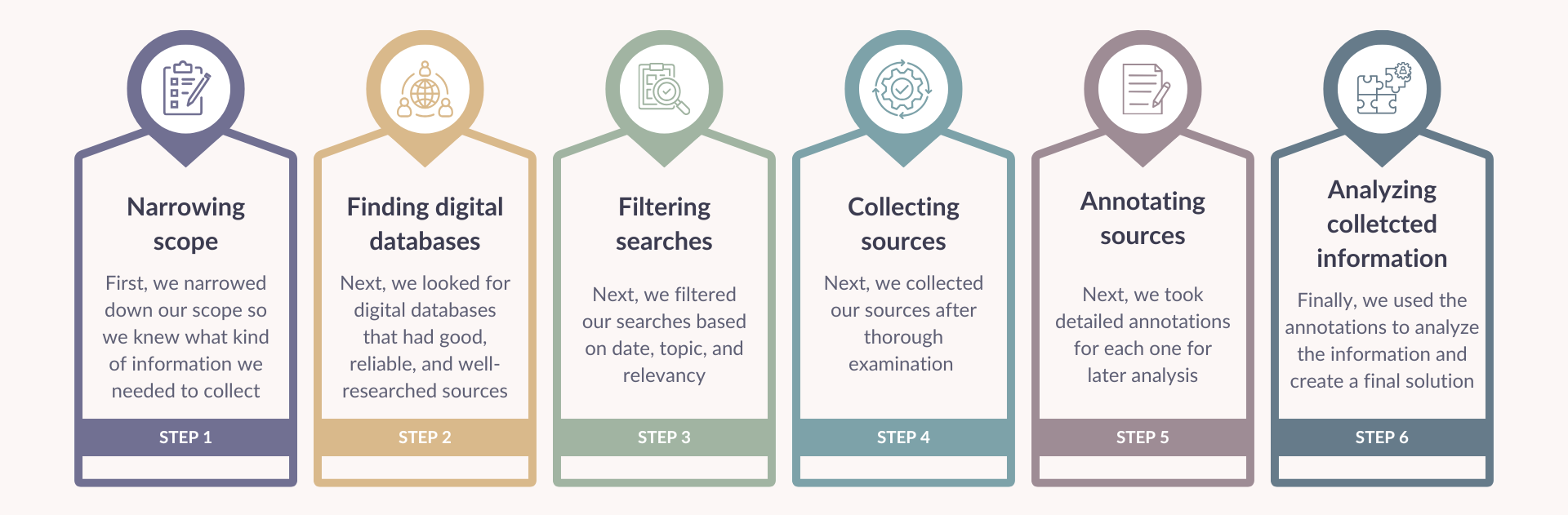
Our project relied on secondary research of external sources for the analysis conducted and the solutions
created. Below is a figure that summarizes all the steps that were taken to collect infrormation,
how the information was used, and where the information was collected. Additionally, a survey was conducted to pool
information about the public's general awareness of cybersecurity attacks that are most prevalent in the remote work era.
The survey questions can be viewed here. This allowed us to collect some of our
own information alongside the analysis conducted through secondary resources.
Final Solutions
Solution 1: Small to medium sized businesses
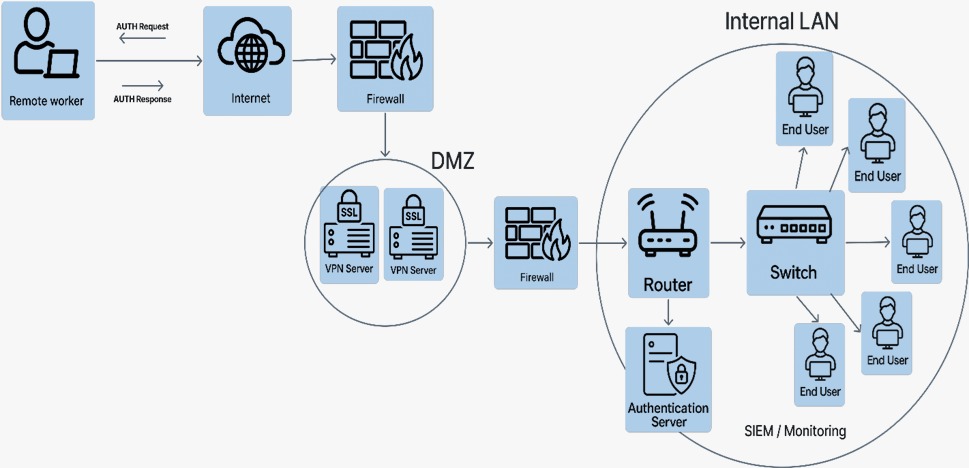
Most of the implementation utilizes SSL VPN configurations to leverage its low cost of deployment and maintenance,
and its ease of use for small networks. The VPN servers are in a DMZ, and their functionalities and role in the architecture
is defined in the table below. The function of the DMZ is to protect the traffic moving between the VPN servers to the internal
network and the external, shared network, to the remote user. The firewalls protect both the internal network, and ensure that if
there is malicious traffic infiltrating the system, it does not affect the remote worker as well.
Solution 2: Large, multi-site enterprises
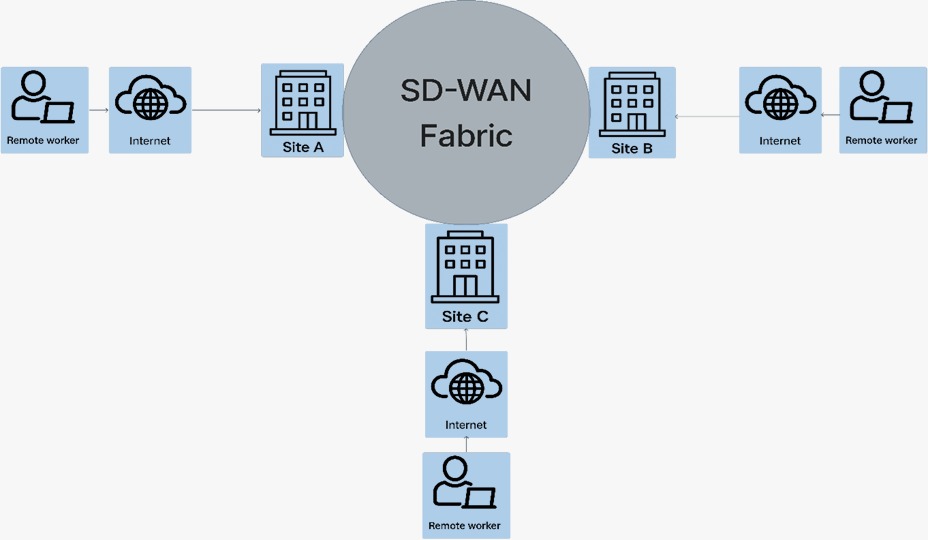
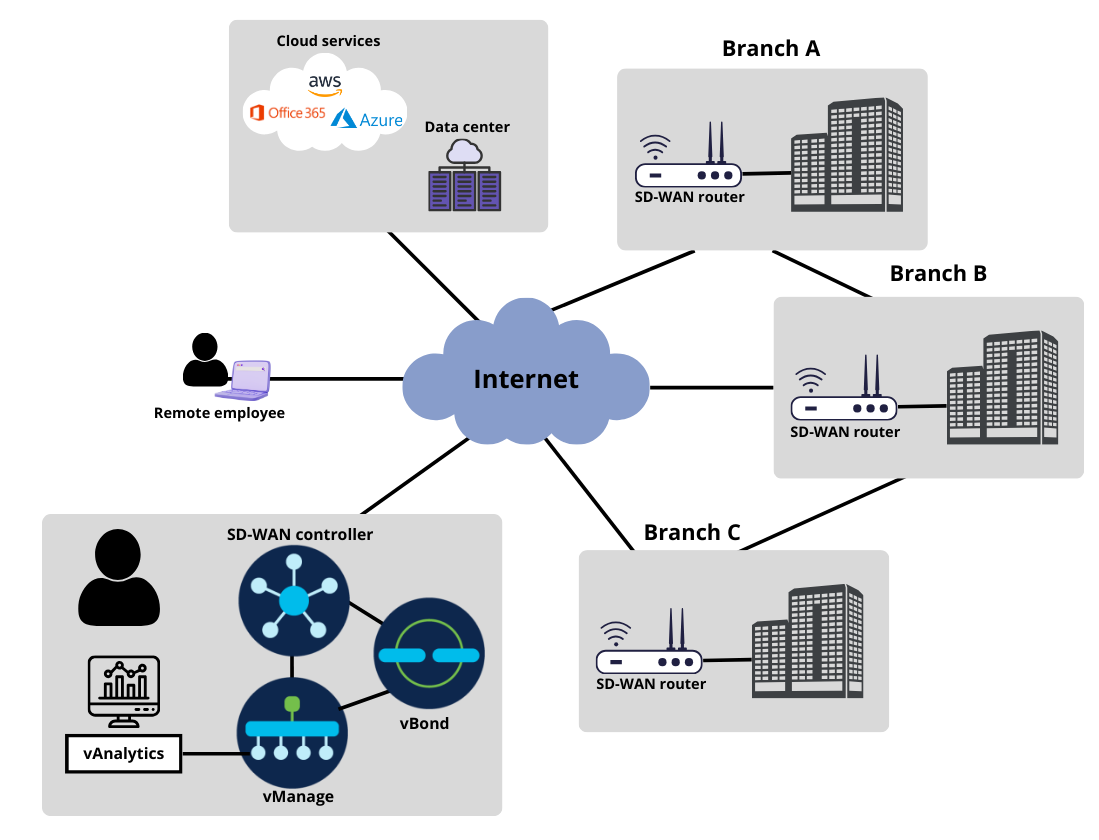
This diagram shows how different remote workers can connect to the organization's branches and access internal resources through the SD-WAN fabric.
This is through the use of SD-WAN edge devices and remote SD-WAN services such as vManage, vBond, and vAnalysis. This picture shows a basic implementation
of a remote, SD-WAN network that provides one worker with access to an enterprise's multiple resources, including cloud services and company sites. It also shows
how a system administrator can remotely manage the network using the afforementioned services.
Solution 3: Large, cloud-integrable businesses
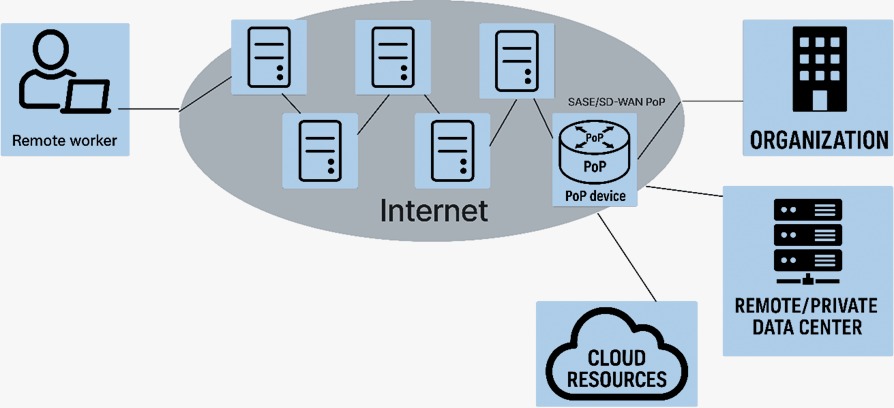
This implementation is built off both the SD-WAN concept, but it more specifically considers
how it can integrate into a cloud-native architecture. In this theoretical example, the
organization has a private data center, and so each remote worker and internal worker must be
provided with secure access to the cloud resources. In some cases, certain employees are given
access to the data center, depending on job role and privileges. Additionally, the presence of
different inspection points allows for continuous authentication and verification and also
ensures that remote workers connecting from various geographic locations can benefit from
reduced latency. The PoP device can also act as an SD-WAN appliance that helps interconnect
the different sites in the SD-WAN fabric.
Conclusion
Through our research, we compared SSL VPN, ZTA, SD-WAN, and SASE across performance, scalability, deployment
complexity, trust model, and typical use cases. This comparative analysis highlighted that no single technology
solves the remote security problem on its own. Instead, combining them in different ways allows organizations
to strike a balance between security, cost, and operational simplicity. SSL VPNs remain a practical choice
for secure remote access, ZTA offers a “never trust, always verify” model suitable for hybrid environments,
SD-WAN improves connectivity and segmentation across branches, and SASE extends ZTA-based controls into the
cloud with globally distributed enforcement points.
Based on our findings, we designed three integrated solution plans: (1) a cost-effective SSL
VPN–centric solution with fundamental Zero Trust principles for small to medium-sized
businesses; (2) an enterprise-scale solution for multi-site organizations combining SSL VPN, ZTA, and SD-WAN to
support branch connectivity and centralized management; and (3) a cloud-integrable approach for larger organizations
that augments the previous elements with NGFWs, Secure Web Gateways (SWG), and Cloud Access Security Brokers
(CASB) within a SASE-style architecture. All three solutions share common strategies such as encryption in
transit and at rest, MFA and RBAC, disaster recovery planning, secure communication
channels, employee training, regulatory compliance, phased deployment, and continuous
logging and auditing.
Limitations & Future Work
Our project has several limitations that can be addressed. The scope was intentionally broad, focusing on
remote work implementations rather than a specific industry, use case, or organization. This generality
makes the solutions more widely applicable but limits the level of detail for sector-specific compliance,
threat models, and operational constraints.
A natural next step is to implement one or more of the proposed solutions in a test environment, using real
or emulated infrastructure. Finally, as remote work technologies continue to evolve, further research should
track and incorporate emerging trends such as Zero Trust Network Access (ZTNA) as a service, AI-driven anomaly
detection, and deeper integration between endpoint detection and response (EDR) tools and cloud-based
SASE platforms.

 This project presents a secure remote network solution plan designed to help organizations protect
their internal assets while enabling a flexible remote workforce. Through an extensive literature
review (2020–2025) and a survey of 170 respondents on cybersecurity awareness, we analyzed the most
prevalent attacks in the remote work era and the essential security practices needed to mitigate them.
We then evaluated four key technologies: SSL VPN, Zero Trust Architecture (ZTA), SD-WAN, and SASE against
criteria such as performance, scalability, deployment complexity, and trust model, and designed three
integrated solution plans tailored to different organization sizes. The resulting frameworks balance security,
cost, and usability, and highlight the central role of employee training, regulatory compliance, and phased
deployment in securing remote environments.
This project presents a secure remote network solution plan designed to help organizations protect
their internal assets while enabling a flexible remote workforce. Through an extensive literature
review (2020–2025) and a survey of 170 respondents on cybersecurity awareness, we analyzed the most
prevalent attacks in the remote work era and the essential security practices needed to mitigate them.
We then evaluated four key technologies: SSL VPN, Zero Trust Architecture (ZTA), SD-WAN, and SASE against
criteria such as performance, scalability, deployment complexity, and trust model, and designed three
integrated solution plans tailored to different organization sizes. The resulting frameworks balance security,
cost, and usability, and highlight the central role of employee training, regulatory compliance, and phased
deployment in securing remote environments.